
How To Identify What’s Eating Your Plants
Learning how to identify pests on your plants is important for all gardeners but especially for new gardeners wanting to grow food organically.
It’s never fun to be walking through your garden and to notice that something just isn’t right. You might notice large holes in your leaves or tiny holes. Or worse, maybe entire leaves are missing from your plants!
As organic gardeners, you don’t want to blindly start applying insecticides at the first sign of a garden pest. You’ll want to first identify the problem and second make sure you use the right technique to control the problem.

Can’t you just use organic pesticides? Yes, but keep in mind that not all organic pest controls are safe for the beneficial insects that will be in your garden, and not all organic insecticides work for all pests. My goal is to help you learn how to identify the culprit pests and then give you guidance on how to deal with the problem.
Before we begin, if you’d like to watch a podcast episode instead about how to identify what’s eating your plants, you can watch it here:
How to Identify Which Garden Pests Are Eating Your Plants
Let’s learn how to identify which garden pests are eating your plants with these topics:
- Identify The Problem
- Insect is Present, But No Damage
- Top Portion of Plant is Cut Off
- Large Holes, No Excrement Visible
- Large Holes, Excrement Visible
- Plants Cut Off at Soil Line
- Small Round Holes in Leaves
- Puckered and Twisted Leaves
- Skeletonized Leaves
- Defoliated Plants
- Bleached Out Portion of Leaves
- Tips to Help You Identify Problem Pests
- Tip #1: Use Google
- Tip #2: Use a Magnifying Glass
- Tip #3: Go Out at Night
- Tip #4: Understand the Stages of a Bug’s Life
- Solution to Organic Pest Control
- Good and Bad Bugs
Don’t forget to snag your 2024 Garden Planner now to help you on your journey of effective gardening.
Identify the Problem
As we begin, it’s important to learn how to identify what’s eating your plants. As a new gardener it can be a challenge to figure out if that insect you just saw in your garden is an actual pest or not.
Insect is Present, But No Damage
The first problem you might see encounter is that you see an insect, but you don’t see any damage. You might find yourself panicking and wondering what you should do next!

This is a completely normal reaction. Let me encourage you to take a step back and remember that not all garden insects are harmful. In fact, the majority of garden bugs are either good bugs or benign. They aren’t harmful nor beneficial, but they are an essential part of the ecosystem and that’s why it’s important we don’t get rid of all the bugs in our garden.
Your first step is to try and identify the bug, then you can see if it’s a good bug or a bad bug, even if you don’t see any plant damage. There are lots of ways to identify insects and my favorite is an app called Picture Insect.
You can also use Google or your favorite bug book. Remember, it’s important to identify the insect so you can know for sure if it’s harmful or beneficial.
If you still can’t figure out what the bug is, then you’ll want to watch the plant and see if any damage occurs over the next few days. If it’s truly a problem, you are going to start seeing evidence on your plant. In the meantime, resist the urge to panic spray!
Top Portion of Plant is Cut Off
Have you ever walked into your garden and noticed that the entire top portion of a plant looked like it was cut off, as if a weed eater had just taken the top off your plant leaving only a stub? I’ve had this happen before and after further investigation I’ve learned that the culprit most likely is either rabbits or deer.
In this case, you would want to use some type of repellent to keep them off your plants. A good short term solution is to spray on a safe repellent wherever you notice the critter is getting inside of your garden. A long-term solution is to invest in a cage, barrier, or a fence.
If all else fails you can look for footprints, droppings, and bite marks on crops. Or, you can even identify garden invaders through game cameras.
Large Holes, No Excrement Visible
Next on my list of how to identify what’s eating your plants is if you notice large holes chewed in the leaves of your crops, but you don’t see any excrement nearby. In other words, you don’t see anything that the insect left behind.

The problem could be several different things. You could be dealing with a beetle, earwig, slug, snail, or grasshopper. These types of pests are often visible during the day and you can find them by looking underneath the leaves of your crops.
There are also times when these insects can only be seen at night. In order to properly identify them, you may want to go in your garden at night with a flashlight when most insects are feeding.
Large Holes, Excrement Is Visible
Our next problem is similar to the previous one except for one small difference. This time you will see large holes chewed in your leaves, but you will also see evidence of excrement left behind. Typically the excrement is black and small and is just sitting there on the leaves.
Most often this will be caused by a worm, which should be visible to you during the daytime.

Plants Cut Off At Soil Line
Another problem you might encounter when you are trying to identify what’s eating your plants is finding your plants are cut off at the soil line. You may notice that small seedlings you just planted are simply just gone, or tipped over.
Cutworms are usually the culprit. Cutworms like to chew your plants right at the soil line. Earwigs, pill bugs (also known as roly polies), and mole crickets can also cut plants off at the soil line.
You might see more pill bugs if you choose to use leaf litter as mulch in your garden. Pill bugs are easier to notice and identify than cutworms, but the point is, you need to identify what the garden pest is so you know the best way to fight against it.
A lot of times the best way to treat this insect problem is protect it while it’s small and then wait. By the time it grows to maturity the plant will outgrow the pest.
Small Round Holes in Leaves
Small round holes in your leaves are very common in the early spring and often this is due to flea beetles. Most of the time you can see the flea beetles, even though they are very small.
The presence of flea beetles is indicated by the shotgun pattern of the plant leaf damage. If you know ahead of time that your area struggles with flea beetles, then covering your plants ahead of time with insect netting is a great idea.
Puckered and Twisted Leaves
You might notice puckered and twisted leaves on one of your plants. Sometimes twisted leaves are an indication of herbicide damage, but they can also be caused from insect damage. Aphids and mites can cause leaves to pucker and twist, especially on tomatoes.
If you notice puckered or twisted leaves, look a bit closer and see if you notice an aphids or mites and often they will congregate on the underside of your leaves. In the case of peppers or tomatoes, if your plants are just starting to flower, aphids and mites love getting on those new flowers because of their sweetness.
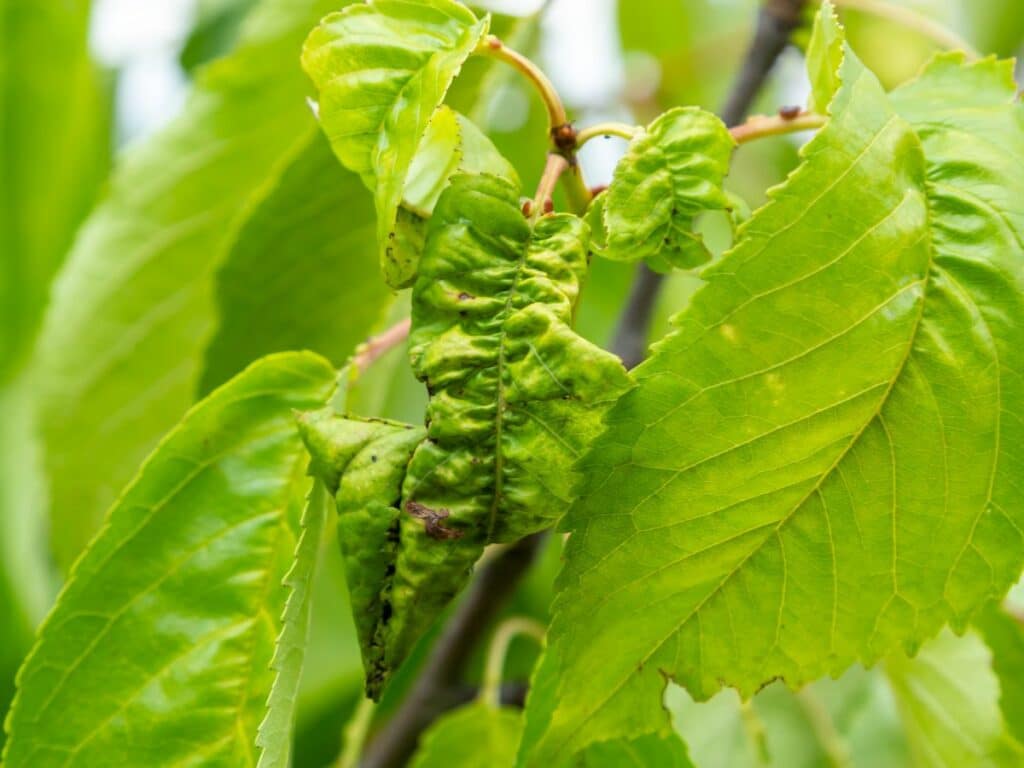
In an outdoor garden, I generally don’t do anything to fight them. They are good food for other beneficial insects, so it’s best to just leave them alone. If you are having an aphid problem in a greenhouse, you can try spraying water on the plant to get the aphids off, or try adding worm castings to the soil. Worm castings can cause a systemic reaction for the aphids and clear up your problem.
Remember, typically aphids are not a huge problem in the garden, but if they do seem to be causing a bigger problem than you can handle, you can look up other ways to organically fight them.
Skeletonized Leaves
Sometimes you’ll notice that the leaves on your plants look skeletonized. These leaves look like they have been eaten, but not completely, so that they look just like a skeleton. This type of damage is usually caused by a bigger beetle.

Most of the time you can see the beetle either on top of the leaves or on the underside, especially if it’s a bad infestation. I’ve also noticed that grasshoppers can cause skeletonized leaf damage as well, especially later in the season.
Defoliated Leaves
Another problem you might notice is defoliated leaves. This type of problem presents with most of the leaves being gone and maybe only the stems remain.
Usually this type of damage is caused by worms, grasshoppers or beetles. This is a very common problem with tomato plants being attacked by tomato hornworms.
Bleached Out Portion Of Leaves
Our next garden problem is bleached out portions of leaves, when you can see a difference between healthy and unhealthy portions of leaves on your plant. Often this indicates the presence of an early infestation of a beetle, but if the bleached portions are in the shape of lines, you’re looking at a leaf miner.
Thankfully a leaf miner is usually only a cosmetic problem for your plants and doesn’t cause major damage.
Tips to Help You Identify Problem Pests
The most important thing to remember when trying to identify what’s eating your plants is that identifying the problem is the first step to fighting the problem. There are four other tips that will also help you to identify the problem.
Tip #1: Use Google
Our first tip is to Google the plant and see what possible pests could attack it. Having that list of possibilities can help you narrow down your problem. Remember that most insects prefer certain plants over others.
Use Google to help you narrow down which insects could potentially be eating your plant and that will at least give you a direction to head in when trying to identify your pest. Garden pests can also be regional, so make sure you search for them based off your particular region as well to narrow it down.

Tip #2: Use A Magnifying Glass
Some garden pests are very small, and using a magnifying glass will help you locate what is eating your plants. Sometimes, you’re going to see the damage with your naked eye, so having a magnifying glass will help you see the actual insect, too.
Tip #3: Go Out At Night
Get outside in your garden at nighttime, armed with a flashlight. Often this will be the only time that you will see the pest that is eating your plants. It’s especially important to go out into your garden at night if you are having trouble identifying the insect and have tried everything you can think of to do during the day to figure it out.
Tip #4: Understand the Stages of a Bug’s Life
All bugs have stages of their life. In each stage of life, the bug looks different. Not only do you need to know what your garden pest looks like as an adult, you might also want to know what it looks like at other stages of its life so you can know if those eggs, larva, nymphs, or adults you see are good or bad.
Solution to Organic Pest Control
Learning how to identify what’s eating your plants is a vital skill for any gardener. By taking the time to observe and research the pests in your garden, you can apply the right organic methods to protect your plants without harming beneficial insects. Remember, patience and careful observation are key.
Utilize tools like insect identification apps and gardening resources to assist you. With these strategies, you’ll be better equipped to maintain a healthy and thriving garden.
A great solution to pest control in your garden is to watch the Beginner’s Garden Pest Control Workshop. You can find out more about that here.
Another great resource that we have is our Guide to Good and Bad Bugs. You can grab it here now. https://journeywithjill.net/goodandbadbugs
Free Resources
Get Free Access to My Beginner’s Garden Resource Vault of 20+ Printable Gardening Guides
I’m living proof that a beginner can grow a rewarding garden. And I want to help you grow yours.


Considering the fact that google has decided to get into politics, I highly recommend Brave or DuckDuckGo for a search engine instead.